News + Reviews
Thursday, October 22, 2026
Posted in Blog
Conscious Connected Breathing vs Other Breathwork Methods: What’s the Difference?
By Alan Patrick Dolan, Founder of Breathguru® • 23 years of breathwork experience
Breathwork has become something of an umbrella term, covering a wide range of practices that are, in some cases, quite different from one another. Here is a plain-language guide to how conscious connected breathing relates to some of the other methods you may have come across.
Conscious Connected Breathing
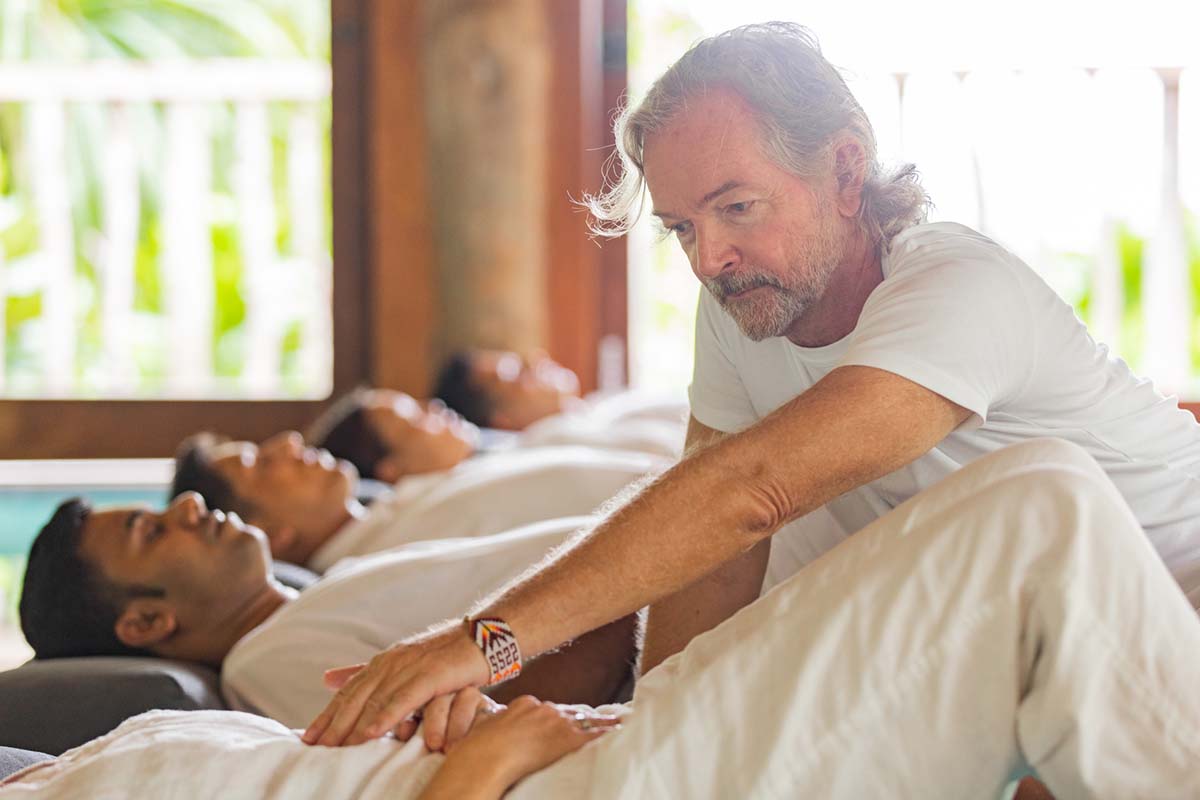
Conscious Connected Breathing (CCB) involves breathing in a continuous, circular rhythm — the inhale and exhale joined without a pause. The breath is diaphragmatic: full, deep, and belly-led. Sessions are conducted lying down, with a trained practitioner guiding and supporting the process. My approach emphasises safety, accessibility, and depth at the client’s own pace.
Holotropic breathwork
Developed by psychiatrist Stanislav Grof, holotropic breathwork uses fast, deep breathing combined with evocative music to produce non-ordinary states of consciousness. Sessions tend to be three hours or more, conducted in groups. It can be very powerful, but is generally more intense than CCB and is not suitable for beginners without careful preparation.
Transformational Breath
Transformational Breath is a trademarked system combining connected breathing with body mapping and affirmations. It is one of the methods I trained in early in my career before developing my own approach. CCB and Transformational Breath share the connected breathing pattern as their foundation, but differ in their additional techniques.
Rebirthing breathwork
Rebirthing, developed by Leonard Orr in the 1970s, also uses connected circular breathing and operates on the premise that unresolved early experiences can be accessed and released through the breath. CCB draws from the same tradition but without the specific rebirthing framework.
Pranayama
Pranayama is the traditional yogic system of breath regulation, encompassing a wide range of techniques. CCB and pranayama are quite different in their origins, philosophy, and mechanism. They can complement each other, but they are not interchangeable.
Wim Hof Method
The Wim Hof Method combines a specific breathing technique with cold exposure and meditation. It has a strong evidence base for certain physiological effects, particularly immune function and cold tolerance. The Wim Hof technique and CCB are different practices — Wim Hof is primarily a performance and resilience practice; CCB is primarily a therapeutic and integrative one.
Which approach is right for you?
If you want an accessible, safe, deeply effective practice that works with the nervous system and the body, conscious connected breathing is a strong choice. I’ve spent 23 years walking this path with my clients, and I would not have kept walking it if the results were not genuine.
If you’d like to experience Conscious Connected Breathing for yourself, I offer 1-1 sessions in London and online.
Tuesday, September 22, 2026
Posted in Blog
What Happens in a Conscious Connected Breathing Session?
By Alan Dolan, Founder of Breathguru® • 23 years of breathwork experience

If you’ve been curious about conscious connected breathing but aren’t quite sure what you’d be letting yourself in for, you’re not alone. It’s one of the questions I hear most often from people who are new to breathwork. So let me walk you through it — honestly and practically, from the moment you arrive to the moment you leave.
First things first: what is conscious connected breathing?
Conscious connected breathing is a specific breathing technique in which the inhale and exhale are joined in a continuous, circular rhythm — no pause between the two. That’s it at its most simple. But the effects of breathing this way, consistently and with guidance, can be profound. Over more than 23 years of practice, I’ve seen it help people with anxiety, stress, insomnia, emotional blocks, and a great deal more besides.
Before the session
If we’re working together for the first time, we’ll begin with a conversation. I want to understand what’s brought you to breathwork, what you’re hoping to experience or work through, and whether there are any health considerations I should be aware of. Conscious connected breathing is very safe, but there are a small number of contraindications — certain heart conditions, epilepsy, first-trimester pregnancy — and it’s important we cover these before we begin.
There’s nothing to prepare in advance. You don’t need any prior experience of breathwork, meditation, or yoga. All I ask is that you arrive in comfortable, loose clothing — and that you haven’t eaten a large meal in the hour or two beforehand.
During the session
You’ll lie down — on a mat, a futon, or a treatment table — and I’ll guide you into the breathing pattern. The breath itself is diaphragmatic: deep, full, and continuous. I’ll be with you throughout, offering guidance, reassurance, and occasionally light touch to help you release tension held in the body.
Sessions typically last between 60 and 90 minutes, though the active breathing portion is usually around 45 minutes to an hour.
What you experience during that time is entirely individual. Some people feel a deep physical release — tingling in the hands, warmth spreading through the body, a sense of the chest opening. Some experience emotional release: tears, laughter, or simply a wave of feeling that passes through and leaves them calmer. Some simply feel very, very relaxed. There is no right or wrong experience — whatever arises is what your body and mind needed to process.
What I consistently aim for is a session that is safe, grounded, and free from unnecessary intensity. Breathwork does not need to be dramatic to be effective. My approach is to guide you gently into the depth that is right for you, not to push you towards catharsis for its own sake.
After the session
We’ll always allow time at the end for integration — lying quietly, letting the experience settle. This is not a time to rush. I’ll check in with you before we move into a brief conversation about what came up and what you noticed.
Most people leave feeling lighter, clearer, and more at ease than when they arrived. Some feel tired in a pleasant, deeply-rested way. Occasionally people feel a little emotional for a day or two afterwards — this is normal and usually passes quickly. I’m always available by email for questions in the days following a session.
How many sessions do I need?
A single session can be genuinely transformative — I’ve seen it many times. But like any practice, conscious connected breathing deepens with repetition. Most people find that three to five sessions gives them a strong foundation and a sense of how to work with the breath independently. The longer retreats I offer in Lanzarote compress this process significantly, with twice-daily sessions over four to five days.
If you’d like to explore what conscious connected breathing could do for you, I offer 1-1 sessions in London and online via Zoom.

Client Feedback
Posted in Client testimonials
“Having experienced Alan’s transformative retreats in person multiple times, never in my life did I think I could have the same transcendental experience online, from afar. Until I did. Over and over and over again.”
Leah Taj Joseph

Client Feedback
Posted in Client testimonials
“Although Alan is not physically with you during an online session, he is vibrationally present and senses what is going on with you. I have found him able to guide me through issues and help me get a better focus. It’s also great to talk through what comes up, and that is akin to seeing him in person. Alan is a caring and intuitive teacher who has helped me tremendously on my journey. I have found that the longer I engage in the practice of conscious connected breathing, the more benefits I receive.”
Tina Baker
Client Feedback
Posted in Client testimonials
“Having supervision calls with Alan has been such a grounding support in my ongoing commitment to running a knowledgeable and professional breathwork business. His guidance, expertise and genuine care really does allow space to explore, expand and improve my capacity in both my Breathwork environment and personal development”.
Susie
Monday, June 15, 2026
Posted in Blog
How to Choose a Breathwork Practitioner
By Alan Patrick Dolan, Founder of Breathguru® • 23 years of breathwork experience
Breathwork has grown enormously in popularity over the past decade, and with that growth has come an increasing number of practitioners offering an increasing range of approaches. Some are exceptional. Some are well-intentioned but undertrained. And some, frankly, are more interested in creating a dramatic experience than in your genuine wellbeing.

So how do you choose well? Here is what I would look for — speaking as someone who has been practising and teaching conscious connected breathing for over 23 years.
1. Training and credentials
Breathwork is not a regulated profession in the UK, which means anyone can call themselves a breathwork practitioner without formal training. This makes credentials more important, not less. Look for practitioners who have completed a recognised, accredited training programme — ideally one that covers anatomy, physiology, contraindications, trauma-informed practice, and supervised case work. Ask directly: where did you train, how long was the programme, and are you a member of any professional body such as the International Breathwork Foundation?
2. Experience
There is no substitute for experience. Working with the breath — and with the range of responses it can produce — requires a practitioner who has sat with many different people across many different circumstances. I would look for someone who has been practising for several years and who can speak fluently about the variety of experiences they have worked with.
3. A clear approach to safety
Any practitioner worth working with should be able to tell you clearly what the contraindications for their method are. If a practitioner waves these away or doesn’t seem familiar with them, that is a red flag. Safety in breathwork also means emotional safety: a practitioner who creates a container in which you feel genuinely held, not pushed.
4. Transparency about what to expect
A good practitioner will explain clearly what will happen in a session, what you might experience, and how they will support you through it. They should not oversell or make guarantees. Breathwork can be genuinely transformative — but transformation looks different for everyone.
5. A genuine connection
Breathwork is intimate work. You are, in a sense, handing your nervous system to another person for an hour or more. You need to feel safe with them — not just competent, but genuinely trustworthy. Trust your instincts during any initial conversation.
Questions worth asking before you book
- Where did you train, and how long was your training?
- How long have you been practising?
- What contraindications do you screen for?
- What happens if I have a strong or difficult experience during a session?
- Are you a member of any professional breathwork body?
- Can you share testimonials or references from previous clients?
If you’d like to explore working with me, I’m happy to answer any of the above.
Monday, June 15, 2026
Posted in Blog
What to Expect on a Breathwork Retreat
By Alan Patrick Dolan, Founder of Breathguru® • 23 years of breathwork experience
The idea of a breathwork retreat is appealing to a lot of people — a few days away from ordinary life, space to go inward, the possibility of something shifting. But it can also feel a little daunting, especially if you’ve never done breathwork before.

Having hosted retreats for most of my working life, I know that the unknown is often the biggest barrier to booking. So let me walk you through what a Breathguru® retreat in Lanzarote actually involves.
Arrival
I collect guests from the airport personally. That journey — usually around 30 minutes — is the beginning of the decompression process. By the time we arrive at the villa, the conversation has usually already moved somewhere real.
The villa is small and intimate — we take a maximum of four guests at a time, usually fewer. This is deliberate. The retreat works because of the depth of individual attention each person receives, and that depth is only possible in small numbers.
The daily rhythm
Each day follows a gentle structure. Mornings begin slowly — breakfast together, time to settle. The first breathwork session is usually in the late morning: a one-to-one session with me, lasting around 90 minutes including integration time. Afternoons are largely unstructured. Lanzarote is a remarkable island — volcanic, otherworldly, unlike anywhere else in Europe — and many guests find that time spent in nature is a natural extension of the morning’s work.
The second session of the day is a group breathwork session in the evening. Having individual and group sessions on the same day creates an interesting dynamic — the morning session opens something, and the evening session often takes it further. Meals are prepared by a local chef and taken together. The food is vegetarian, beautifully made, and very much part of the retreat experience.
What happens in the sessions
The one-to-one sessions are where the deepest individual work happens. I tailor each session to the person in front of me — where they are that day, what came up yesterday. No two sessions are alike. What you experience will be entirely your own.
A note on intensity
I’m sometimes asked whether the retreat will be intense. My honest answer is: it will be as deep as you allow it to be, and I will never push you beyond what feels right for you. I am not interested in engineering dramatic experiences. I am interested in what is genuinely useful and lasting for each person I work with.
Departure and afterwards
Most guests leave feeling lighter than when they arrived — clearer, more settled, with a different relationship to their own breath and body. I stay in touch after the retreat and am available by email as things continue to integrate. The work doesn’t stop when you board the plane home.
Breathguru® retreats take place twice yearly in Lanzarote. To find out more or enquire about availability, visit the retreats page.
Monday, June 15, 2026
Posted in Blog
Breathwork for Anxiety: Does Conscious Connected Breathing Work?
By Alan Patrick Dolan, Founder of Breathguru® • 23 years of breathwork experience
Anxiety is one of the most common reasons people come to see me. They’ve often tried other things — therapy, medication, meditation — and while those may have helped, they’re looking for something that works at a deeper level. Something that reaches the body, not just the mind.

Conscious connected breathing does exactly that. Here’s why — and what I’ve seen it do for people over more than two decades of practice.
The connection between breath and anxiety
When we are anxious, our breathing changes — it becomes shallow, fast, and chest-led. This activates the sympathetic nervous system: the body’s fight-or-flight response. More shallow breathing leads to more activation, which leads to more anxiety. It’s a cycle that many people are trapped in without realising it.
The reverse is also true. Slow, deep, diaphragmatic breathing activates the parasympathetic nervous system — the rest-and-digest response. It signals to the body that it is safe. Heart rate slows. Muscles soften. The mind quietens.
Conscious connected breathing works with this relationship between breath and nervous system, but takes it further. The continuous, circular rhythm — inhale and exhale joined without pause — creates a sustained shift in the body’s physiological state. It’s not just relaxation. Over time, it recalibrates the nervous system’s baseline, so that the anxious response becomes less automatic and less overwhelming.
What the research now tells us
This is an area where the evidence has moved significantly in recent years, and it’s worth being specific about what the research actually shows.
The most important recent study is the work of Dr Richard Blake, a psychotherapist and breathwork researcher based at the California Institute of Integral Studies. His randomised controlled trial — published in February 2026 in the Journal of Affective Disorders, the highest-impact-factor journal to have published research on conscious connected breathwork — is the largest of its kind to date. 107 adults with mild to severe anxiety symptoms were randomly assigned to either a six-week online CCB intervention or a waitlist control group. The results showed a statistically significant and clinically meaningful reduction in anxiety symptoms in the breathwork group. Notably, the intervention was conducted entirely online — suggesting that the benefits of CCB are accessible even outside an in-person setting.
This matters not just as a data point but as a landmark. We now have peer-reviewed, randomised controlled trial evidence, published in a major psychiatric journal, demonstrating that conscious connected breathwork reduces anxiety. That is a significant step forward for the field.
Blake’s work sits within a broader body of growing evidence. A 2023 scoping review published in the National Institutes of Health database examined 16 clinical studies on breathwork interventions for adults with clinically diagnosed anxiety disorders and found that a range of breathwork approaches yielded significant improvements across the board. A 2024 comparative study also found that breathwork produced a roughly 14% improvement in overall wellbeing and approximately double the gain in resilience compared to the control group — with changes that lasted for months after the intervention ended.
What I’ve seen in 23 years of practice
The research matters, but so does lived experience — mine and my clients’. What I can tell you, from over two decades of working with people one-to-one, is this: conscious connected breathing reaches places that talking cannot easily reach.
Anxiety is often held in the body — in a tight chest, a clenched jaw, a permanently braced diaphragm. Breathwork addresses these physical manifestations directly. Many clients describe a moment during a session when something simply releases — a tension they had been carrying so long they had forgotten it was there.
Is breathwork right for everyone with anxiety?
For most people, yes. There are some contraindications — including certain eye conditions, a history of aneurysms and certain severe mental health disorders — so this form of breathwork isn’t recommended for people experiencing and/or living with these conditions. That’s why I always begin with a conversation before we start work together. Breathwork is not a replacement for professional mental health support where that is needed. It can work well alongside therapy — they are complementary, not competing.
Where to start
If anxiety has brought you to this page, the most straightforward next step is a single 1-1 session — either in London or online via Zoom. One session will give you a clear sense of how conscious connected breathing feels and what it might do for you.
To find out more or to book a 1-1 session, visit the 1-1 sessions page.